
Many of the successful men I work with describe the same strange sequence. Doctors, founders, men running solid businesses. A real win lands, a strong quarter, a promotion, a deal that finally closed. A few people reach out to say well done. Then the night comes, and somewhere after the last message goes quiet, they end up alone with a screen into the early hours.
The bigger the day, the emptier the night that follows. Most of them cannot explain it, because on paper it was a good day, the kind they’d worked hard to earn.
That is the pattern I see constantly in high-functioning men: the quiet link between loneliness and porn, where the emptiest nights tend to follow the most successful days. I want to take the mystery out of it, because the success and the screen are not a contradiction. They are the same story.
Here is what I tell every man I work with: this is not a willpower problem, and you are not weak. Your brain learned to do something, and brains can learn the opposite. That is the whole premise of the work.
Three Quarters of a Million Men, One Quiet Problem
A 2026 survey of more than 7,000 single men aged 18 to 35 in New York, reported across regional outlets, found that half had no female friends at all. Nearly three out of four who were not using dating apps said they had simply stopped trying to find a partner. Most said their social lives had moved almost entirely onto screens. I will be straight about the sourcing: that figure comes from a regional news report of the survey, not a peer-reviewed paper, so I hold it more loosely than the clinical research below.
That is an estimated 761,000 men in a single state whose most consistent companionship arrives through a glowing rectangle. And it is not an outlier: the Pew Research Center documented the same national retreat in 2025, with men reporting fewer close friendships than two decades ago. The coverage called it a loneliness epidemic and stopped there, at the level of a feeling. But loneliness stopped being just a feeling the moment researchers started measuring what it does to the body.
Loneliness Is Not a Mood. It’s a Medical Event.
In 2023 the U.S. Surgeon General issued a formal advisory, with the psychologist Julianne Holt-Lunstad as lead author, reframing loneliness as a public health threat on the order of smoking. The mortality impact of chronic disconnection is comparable to smoking up to 15 cigarettes a day. It raises the risk of premature death by roughly 26%, heart disease by 29%, and stroke by 32%.
Increased risk associated with chronic loneliness. Source: U.S. Surgeon General Advisory, 2023.
Sit with those numbers, because they tell you loneliness isn’t soft. It’s a sustained biological stress state that damages the body the way a pack-a-day habit does. The same advisory found that in 2020 the average American spent about 20 minutes a day in person with friends, down from 60 minutes two decades earlier. Among people aged 15 to 24, that in-person time dropped nearly 70%. An entire generation has been quietly starved of the thing its nervous system needs most.
Among 15- to 24-year-olds the drop was nearly 70%. Source: U.S. Surgeon General Advisory, 2023.
And a nervous system in that kind of deprivation does not sit quietly and wait. It goes hunting for relief, and it reaches for whatever delivers the strongest, fastest signal.
Why the Screen Wins When You’re Starving
When you’re genuinely connected to people, ordinary moments produce enough dopamine to keep you steady. A real conversation. A hand on your shoulder. Someone laughing at the thing you said. Your reward system stays calibrated to human-scale pleasures, and that’s enough.
Strip those connections away and the most efficient dopamine source ever engineered is sitting in your pocket. Pornography delivers a spike that dwarfs anything an ordinary interaction provides: unlimited novelty, instant access, zero risk of rejection. A brain starved of real reward and offered synthetic reward on tap does the logical thing. It rewires to prefer the screen. Not because the screen is better, but because it’s louder.
The neuroscientist Kent Berridge spent years on this at the University of Michigan, and his incentive-sensitization research with Terry Robinson reframes the whole trap. There is a difference between wanting something and liking it, and the two run on different brain systems. The wanting system, driven by dopamine, can crave a reward with overwhelming force long after the liking system has stopped enjoying it. That is the state most men are in by the time they reach me. They do not even like what they are watching. Their brain just wants it, and wanting is the harder of the two to break.
How Loneliness and Porn Feed Each Other
A study of 1,247 people by Butler and colleagues, published in the Journal of Sex and Marital Therapy in 2018, modeled pornography use and loneliness as predictors of each other and found a significant link in both directions. Lonely men are more likely to develop compulsive screen patterns, and those patterns then deepen the loneliness, because every hour in synthetic reward recalibrates the brain so real connection registers a little fainter the next day. Eye contact starts to feel like effort. A conversation at a party feels flat next to the intensity of the night before. So he withdraws, which makes him lonelier, which sends him back. The loop tightens one notch at a time.
Each turn of the loop makes real connection register a little fainter and the screen a little louder.
Dr. Kevin Skinner, a co-author of that same study and the author of Treating Pornography Addiction, names the endpoint plainly: a new kind of loneliness, the loneliness of a man whose relationships are increasingly with images instead of people. He is not choosing screens over people. His brain has quietly stopped registering people as the better option.
It does not stay in the mind, either. When the brain gets conditioned to screen-level intensity, the body follows. A 2021 study in JMIR Public Health and Surveillance of 3,419 men aged 18 to 35 found that 21.48% of the sexually active ones already had some degree of erectile dysfunction, climbing with more problematic pornography use. The wider trend is real too: a 2025 narrative review of erectile dysfunction in young men reports psychogenic ED in men under 40 rising to somewhere between 14 and 28%, up sharply from the single digits a generation ago. These are men in their twenties whose bodies no longer answer a partner the way they answer a screen.
What Actually Breaks It (and One Thing You Can Try Tonight)
None of the men I’ve watched get free did it on willpower. White-knuckling fails because it fights a brain-state problem with discipline. Here’s the honest part, the part that costs me a client: if your severity isn’t high, it usually isn’t worth bringing in a professional yet, and if it’s already severe, where the isolation runs deep and it’s draining the rest of your life, that’s exactly when it is. For everyone in between, the real question is whether you’d rather not gamble on it, because an ounce of prevention is worth a pound, sometimes a ton, of cure later, and the men who deal with a small problem early are the ones who almost never let it grow into a large one. If your isolation is mild and recent, you may be able to move the needle yourself with two changes, and I’d rather you try them first.
The first is connection so small it feels pointless. Not a new best friend by Friday. A real exchange with the guy at the coffee counter. One text to someone you’ve been avoiding. Showing up once a week to anything where bodies share a room. The bar is deliberately low, because the brain rebuilds reward pathways through repetition, not intensity. Twenty small reps beat one grand gesture.
The second you can do tonight. At 10pm, depleted, boredom and loneliness and stress all feel identical, and the hand moves toward the phone on autopilot. Before you pick it up after eight at night, pause five seconds and ask one question: what am I actually feeling right now? Five seconds. It interrupts a loop that’s run unchallenged for years, and that interruption is where change starts to live.
If you try those for a few weeks and the pull is still running your evenings, that’s the signal the pattern is deeper than circumstance, and that’s the point where working with someone who understands the mechanism actually earns its place. Not before.
What This Pattern Means for Successful Men
The New York study made headlines because 761,000 is a frightening number. But the number was never the story. The story is that a generation of men has relocated its inner life onto screens, and the high-functioning men I work with are among them. The ones who come out of it do not get there because anyone shamed them, and not because they found hidden discipline. They get there because they finally understood that the silence after the celebration wasn’t a character flaw. It was a nervous system that had never learned another way to be filled. Once a man can see that mechanism, he can build something better around it.
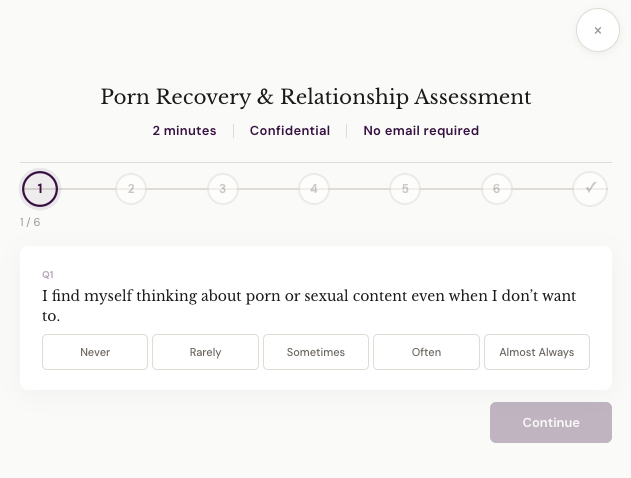
If this is hitting close, the most useful next step is not a sales pitch. It is a 3-minute self-assessment built around what I call the three layers: the neurological, the emotional, and the relational. It shows you which one is actually driving your pattern, so you are not guessing. We do not do shame and we do not do streaks. We do how the brain actually works. Across more than 4,100 clinical sessions, the men who name their layer are the ones who stop guessing and start changing it.
About the Author
Jeffrey holds an M.A. in Clinical Psychology and Marriage & Family Therapy and is the founder of ARISE. Over more than 4,100 clinical sessions, he has helped high-achieving men overcome compulsive porn use and rebuild the connection it quietly eroded. His work combines neuroscience, clinical psychology, and practical behavioral strategy.